I’ve Seen This Movie Before
And the AI skeptics are reading from the same script.
The first time, the room smelled like fixer and hot wax.
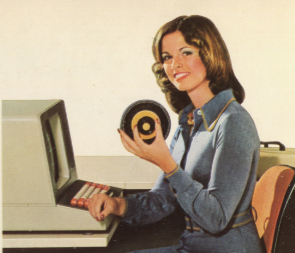
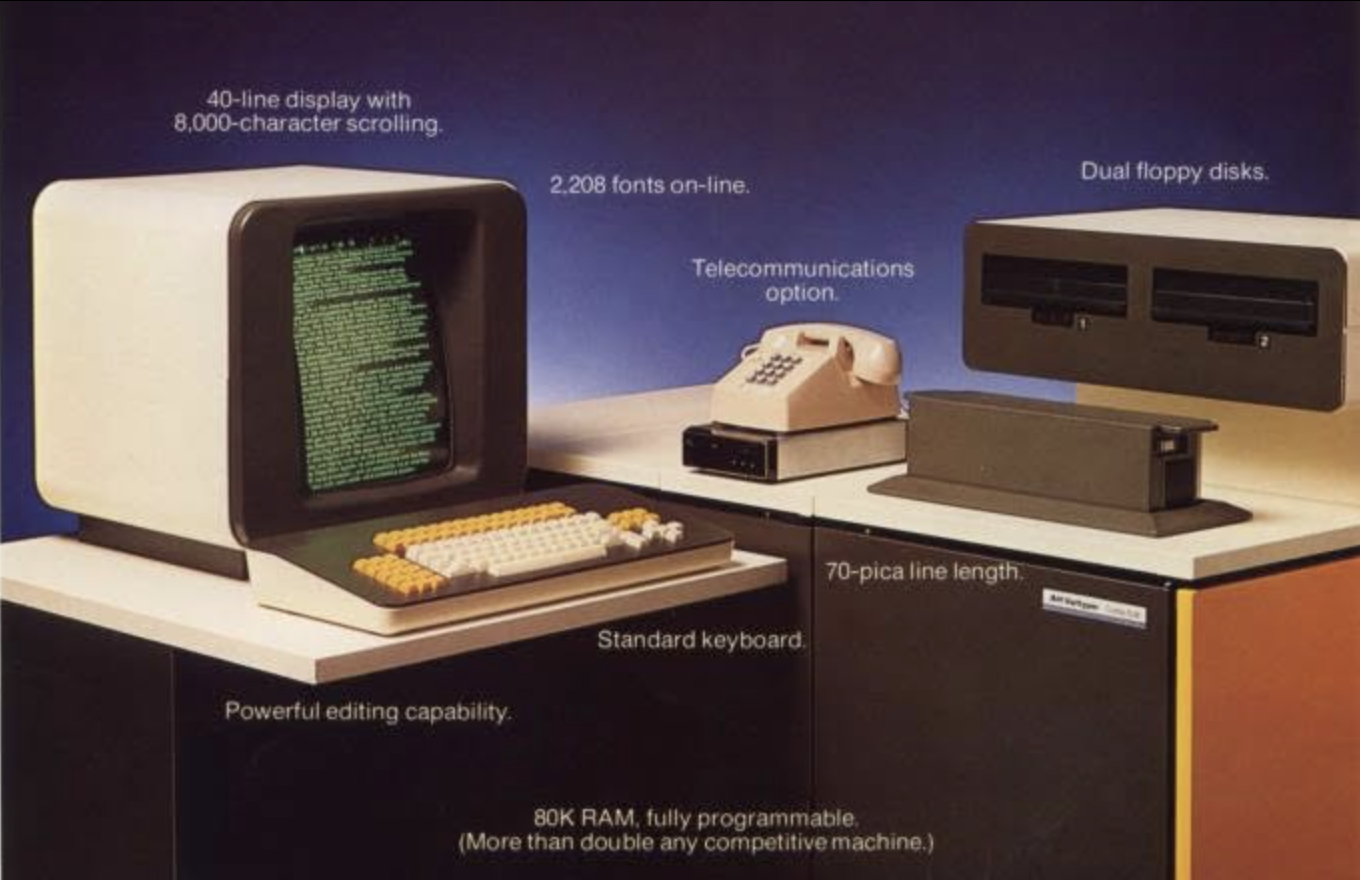
The designer worked in a dark room at the back of the print shop, dominated by an ominous sci-fi console. Tech that couldn’t decide whether it was a tool or a piece of furniture. She sat in a hard white plastic chair built into it, more of a cockpit than a workstation, in front of a small, hooded green screen recessed into the console, pulsing at you, a cursor blinking slow. Much like talking to Mother in Alien.
Except all you did was type a sentence.
To set a line on the AM Varityper Comp/Set 500, you typed it on the keyboard and the words landed on the green screen first, waiting in a buffer while you caught your typos. Then you pressed Return. A whir from the cabinet at your right elbow as the disc spun, the microprocessor working out the spacing to justify the line, then a strobe fired a hard flash through the font disc and a lens, burning the characters onto photographic paper sealed in a cassette. You never saw it happen. The type was exposed in the dark, locked in the cassette, waiting.
You developed it. Fixed it. And the letters resolved out of nothing, crisp and black and exact. There was no cleaner way to set a letter on a page. Not then. Not now.
To change a font, you opened a port on the side of the machine, and pulled out a flat photographic disc that carried the image of every letter in that face. Fonts were serious money, and a shop like ours carried maybe twenty families. That was a small fortune sitting in a drawer.
Size you set from the keyboard. You typed the number and the machine threw the same letter bigger or smaller onto the paper, anywhere from 5 to 36 point.
Then came the part that built the actual page. You ran your fixed strips through a little wax roller and laid them on a board. The designer cut the type out with a razor blade and stuck it down exactly where it belonged. The header. The body. The footer. Drawings went down the same way. Photographs got a halftone screen shot in front of them to break them into dots.
Then the whole board, the entire pasted-up page, got photographed again onto a plate. You developed the plate, fixed it, and clamped it onto an AB Dick offset press, where a craftsman rolled on the ink and transferred the image to paper, one clean sheet at a time.
That was the trade. Discs and lenses and wax and razor blades and a half dozen wet chemical steps, and at every station a person who’d spent years getting good at it.
Then the Macs showed up.
PageMaker. A LaserWriter humming in the corner. And the designer, who knew kerning by eye and could read type backwards through a loupe, looked at the output and laughed.
And she was right. The output was garbage. Jaggy fonts, 300 dots per inch, spacing she wouldn’t sign her name to. “That’s not type,” she said. “That’s a toy.” She said it loud at first. Then late and quiet, after a couple of beers. What happens to me if any kid with a Mac can do this?
She got the severance package anyway.
Because here’s the thing nobody tells you about a real disruption: the skeptics are correct, and it doesn’t matter. The quality was bad. For a while. Then the Linotronic bridged the gap, the laser printers got “good enough,” and the kid with the Mac, who’d spent that whole stretch getting fluent while the masters stood around being right, owned the shop. The craft didn’t die. It moved. It just stopped paying the people who refused to follow it.
The second movie was…well…making movies. In a room that smelled like coffee and anxiety.
There’s an old editor’s line: when things get really bad, at least there are plenty of razor blades around. We cut film with them, so they were everywhere, every drawer, every bench. One trade over and a few years on, another blade in my hand.
By then I was in film, a card-carrying member of the Editors Guild.
The work was as physical as the print shop. You found your frame and cut the film. You spliced the shots together in the order you wanted with a strip of tape, building a scene by hand, one cut at a time. Then you strung the whole reel up through a flatbed, a big editing table that pulled the film past a lens and threw it onto a screen the size of a placemat, so you could finally sit back and watch what you’d built. The shots you weren’t using yet hung in a trim bin like ribbons, labeled and waiting, in case you changed your mind.
Then the digital wave broke. AVID. EditDroid, Domino. Cutting on a computer instead of hanging film in bins and feeding it through a flatbed like God and Moviola intended.
You can guess the reactions, because they were word for word the same. “The resolution is offline garbage.” (True.) “You can’t feel the cut on a screen.” (Also kind of true.) “A real editor works with his hands.” And underneath all of it, the same cold draft I’d felt in the type shop. Folks with thirty years of muscle memory watching the floor tilt.
I had a lot of respect for those editors. Genuinely. Some of them were artists. But respect didn’t slow the thing down by a single day. The offline resolution got better. The systems got faster. And the editors who’d quietly learned the box while everyone else was busy poo-pooing it became the only editors anyone wanted to hire. The trim bins went in the dumpster. The talent that adapted is still working. The talent that planted its flag is gone.
Two industries. Same disruption. Same two reactions. Dismiss the quality, or fear the change. And the exact same ending both times. And not just twice. Image processing. 3D modeling and animation. Game dev. Web. Photography, then motion picture film. CAD. Same movie, different theater, every time.
But the ending is the boring part. Everyone fixates on who lost. Almost nobody asks the better question: what did the new tools actually do?
And it’s not what most people point to. They all changed the same one thing: Iteration.
When the work is a slog, your first idea is your last idea. The first thing you make is “good enough,” because doing it again means doing all of it again. Got a better idea halfway through? First you have to decide whether it’s worth tearing down what you’ve already built just to test it. Usually it isn’t. So you don’t. Every attempt is expensive, so you take fewer of them.
The new tools made trying nearly free. You could test an idea faster than you could explain it. And when trying costs nothing, you stop planning the perfect move and just start moving. Cut, watch, adjust, cut again. It turns into flow. An editor on an Avid laid down more splices in three months than twenty years on a flatbed would ever allow.
That changed more than the craft. It changed the craftsman, and then it changed the work. Look at old typesetting. Look at old films. The pacing, the design, the number of decisions packed into a minute. There’s no comparison. Not because the new people had more talent, but because they got an order of magnitude more reps. Iteration is experience on fast-forward.
Sure we are now drowning in slop. The planning muscle goes soft and plenty of work now skips the thinking entirely. But that’s not the tool. The tool doesn’t stop you from thinking. It just stops charging you to try.
Which is the whole game. The real new masters aren’t the ones with the slickest tool, and they aren’t the old hands guarding the old way. They’re the ones who bring the discipline of the old craft to the iteration speed of the new one. Old judgment. New reps. That person wins every single time.
So you’ll forgive me if I’m not nervous about AI. I’m just… oriented.
I can smell the room. It’s the same room. The output is uneven. It hallucinates, it produces slop, a real writer wouldn’t sign their name to half of it. All true. And I’ve heard “that’s not real writing / coding / design / art” so many times now that I could mouth along. I’ve heard the fear too, dressed up as principle, which is how the fear always dresses.
Here’s what thirty-seven years of watching this taught me. The skeptics are right about today’s quality and wrong about everything that matters. The same clock is already running. The resolution always gets better. And the only variable that has ever mattered, the only one, is whether you spent the disruption getting fluent or getting indignant.
I bought the Mac. I learned the Avid. I was never the most talented guy in either room, but I was in the room, with my hands on the new thing, while the masters explained why it would never work.
The masters were brilliant. The masters were also wrong. And the masters are not who got hired next.
The tool is here. It’s clumsy, it’s improving faster than you want it to, and it does not care even a little whether you approve of its kerning.
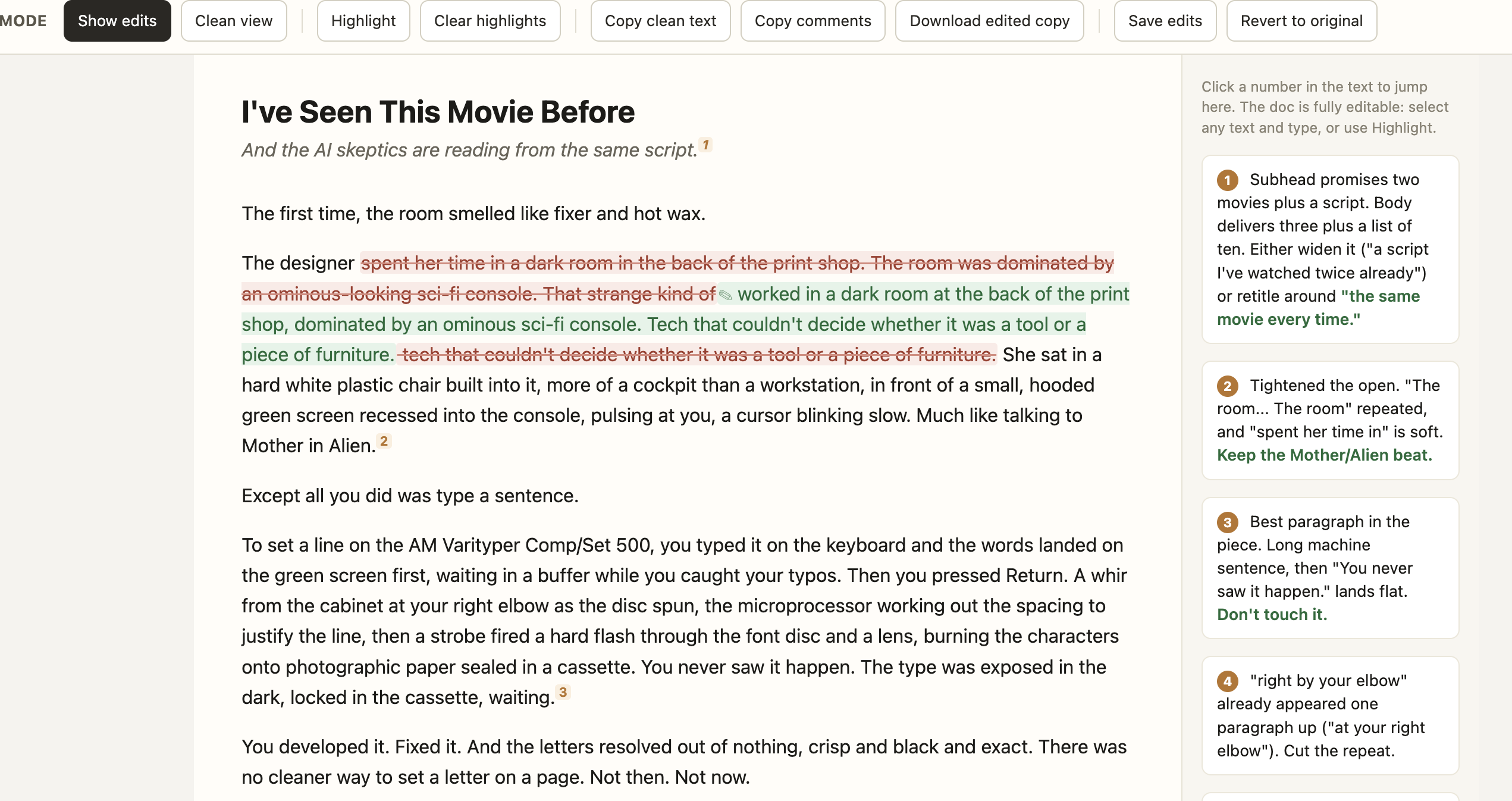
I edited this essay inside a tool that didn’t exist this morning. I had a thought about how I wanted to work and it got built.
Get your hands on the new thing, or get a good bar story ready. I’ve seen how this one ends.